For most parents, this moment arrives with a mix of excitement and a little anxiety. The idea of a playgroup sounds right, but also feels very soon. They’re still so small. Will they cope? Will they even understand what’s happening?
Here’s what years of working with young children have taught us at The Growing Trees: the right playgroup, at the right time, doesn’t take a child away from their sense of safety. It expands it. Slowly, gently, and with more long-term impact than most parents anticipate when they first walk through the door.
Why the Early Years Are So Much More Than a Warm-Up
There’s a misconception worth addressing head-on: that playgroup is simply a stepping stone to “real” school, a sort of waiting room where children pass time before nursery begins. It isn’t. Not even close.
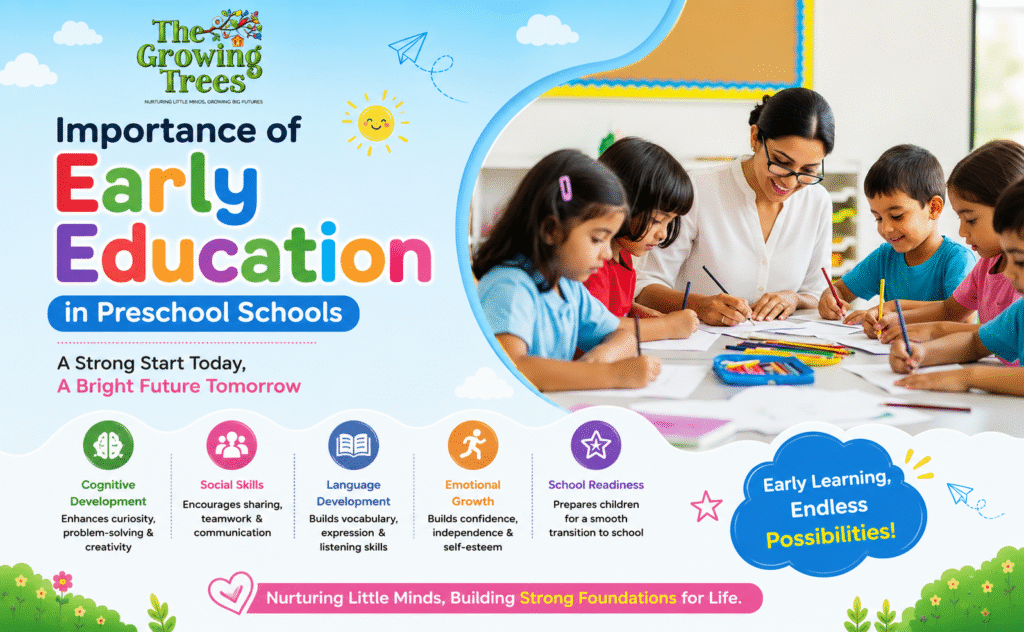
The years between 2 and 4 are among the most neurologically active of a child’s entire life. Language, emotional regulation, social instincts, problem-solving, the foundations of all of it are being laid right now, in these years, through exactly the kind of experiences a well-run playgroup provides.
What looks like children painting and singing rhymes is, underneath the surface, something far more significant. It’s the architecture of a learning mind being quietly built.
A Note on Brain Development
By age three, a child’s brain has already formed approximately 1,000 trillion synaptic connections, more than at any other point in life. Stimulating, responsive environments during this window don’t just help children; they physically shape the brain’s structure and capacity for learning.
The Real Benefits, Not the Brochure Version
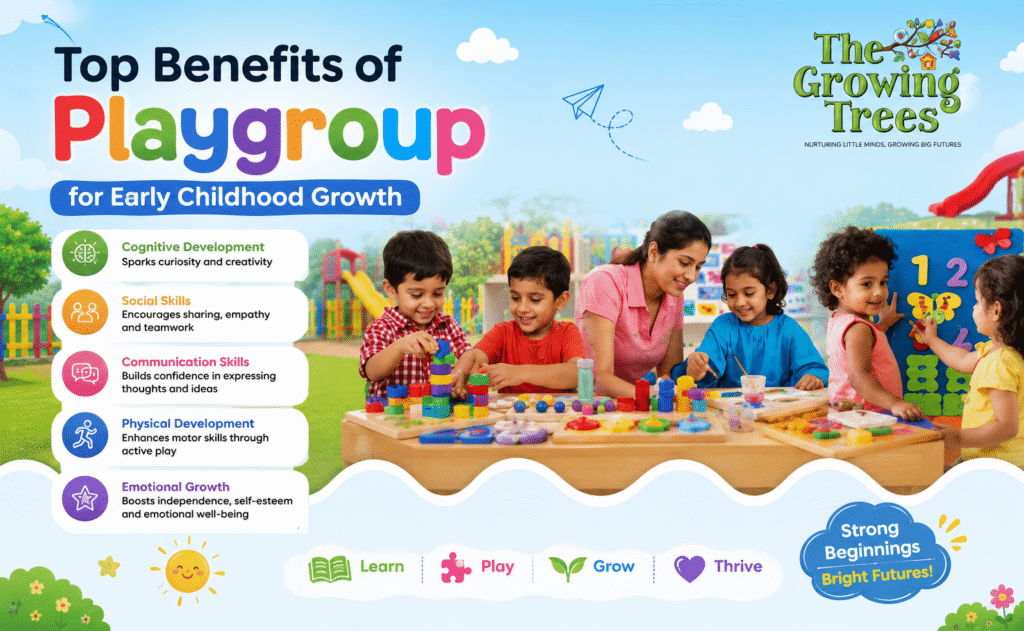
Most playgroup descriptions focus on the obvious: art, music, stories, and outdoor play. All of that matters. But the deeper benefits are quieter, slower, and far more lasting. Here’s what actually changes when a child spends their early years in a good playgroup.
They Learn to Exist Comfortably Outside Their Home
This sounds simple. It isn’t. For a child who has spent their first two years almost entirely in the company of family, the world outside home is genuinely unfamiliar. New faces, new sounds, new expectations. The first job of any good playgroup is not teaching, it’s belonging. When a child starts to feel safe in a space that isn’t home, that’s not a small thing. It’s the foundation on which everything else gets built. At The Growing Trees, we never rush this. Some children take a week. Some take a month. The pace is theirs.
Language Explodes, Often Faster Than Parents Expect
There’s a reason parents frequently notice a sudden jump in vocabulary and expression within the first few months of playgroup. Children learn language most readily through interaction with peers and responsive adults, not through screens or passive listening. In a playgroup setting, a child is surrounded all day by language in context: instructions, stories, songs, conversations, disagreements, and laughter. The brain absorbs all of it. What most parents don’t realise is that even the child who sits quietly at the edge of the group is processing and storing every word they hear.
They Start to Understand That Other People Have Feelings Too
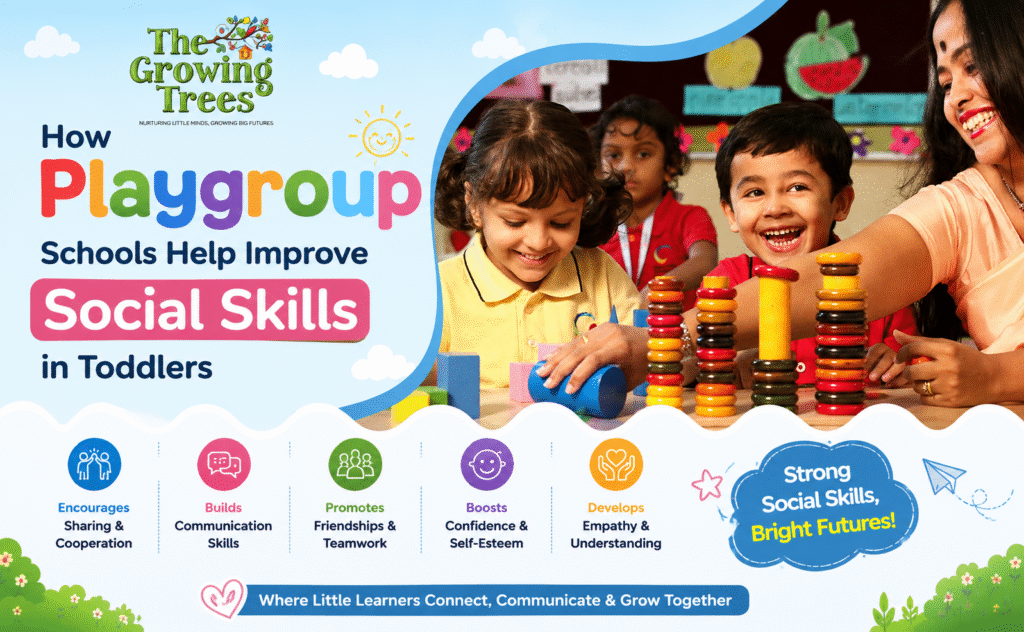
Empathy isn’t a value you can lecture a two-year-old into. It develops through lived experience, through the moment when another child wants the same toy, through watching a friend cry and feeling something stir in response, through slowly, imperfectly learning that the world contains other people with their own inner lives. This social-emotional learning is one of the most undervalued gifts of early childhood group settings. It cannot be replicated at home, no matter how attentive the parents are. It requires other children and a guided environment where those small, charged moments are handled with patience and skill.
Curiosity Gets a Proper Stage
Young children are natural scientists. They want to touch, taste, test, and take apart. A good playgroup in Goregaon West gives that curiosity an actual stage: sand trays, water play, building blocks, art materials, simple puzzles, all designed not to produce a perfect outcome but to invite exploration. Here’s where things get interesting: children who are allowed to follow their curiosity freely in the early years tend to become more confident, more persistent learners later on. The habit of inquiry, trying, failing, adjusting, trying again, is a habit, and it’s formed young.
Routine Creates Security, Not Rigidity
Young children don’t yet have a reliable internal sense of time. When their day has no predictable shape, they can feel subtly unsettled, a low-level anxiety that has no name but shows up as clinginess, erratic moods, and difficulty sleeping. A well-structured playgroup day gives children what their developing minds genuinely need: a rhythm they can trust. Not rigid, not military , just consistent enough that a child knows what’s coming next, and can therefore relax into each moment rather than brace for uncertainty. Most parents notice the effects at home first: a calmer, more settled child in the evenings.
“The child who struggles most on the first day of playgroup often becomes the one who runs in first by the third week. What changed isn’t the child, it’s their trust in the space.”
Playgroup vs. Staying Home: It’s Not Either/Or
Some parents wonder whether they should wait, whether a child at two or two-and-a-half is genuinely ready for something structured outside the home, or whether the earlier years are better spent in the comfort of family alone. It’s a fair question, and there’s no single right answer.
What we’ve consistently seen, though, is this: children who join a playgroup in Goregaon West with a warm, unhurried approach to settling in, where no one rushes them or dismisses their hesitation, make the transition beautifully. And the gains they make during those playgroup years, in confidence, communication, and social fluency, follow them all the way into nursery and beyond.
The children who often struggle more are those who arrive at the nursery in Goregaon West with very little structured group experience. The academics are manageable, but the social landscape, the noise, the sharing, the being one of many, can feel overwhelming when it’s entirely new at age three or four.
Playgroup, done well, is the gentle preparation that makes everything that follows feel like the next natural step rather than a sudden leap.
What Makes a Playgroup Worth Choosing
Not all playgroup schools in Goregaon West offer the same experience. The physical space matters less than most parents initially think. What matters far more is harder to see at first glance, but becomes very clear once you spend time in the environment.
- Do the educators respond to the child, or manage them? There is a real difference, and children feel it immediately.
- Is there space for a child to simply observe? Not every child participates instantly. A good playgroup makes room for the watcher, the hesitant one, the child who needs three weeks before they’re ready to join in.
- Are emotions taken seriously? A child who cries should be comforted, not hushed, not distracted, not told to stop. How a playgroup handles tears tells you nearly everything about its values.
- Is play genuinely free, or is everything directed? Child-led play is not a time-filler. It’s where some of the most important learning of the early years takes place.
- Do parents feel like partners, or like drop-off points? The best early childhood environments treat parents as collaborators in their child’s development, not as people to be politely managed.
The Transition to Nursery, And Why Playgroup Makes It Smoother
Parents who are already thinking ahead to nursery in Goregaon West will find that a good playgroup experience makes that next transition almost seamless. The child arriving at nursery from a settled playgroup background already knows how to exist in a group. They’ve learned to wait, to share, to listen to a teacher’s voice, to handle separation from a parent with growing confidence.
They may still need time to adjust to a new environment, that’s natural and healthy. But the underlying skills are already there, already practised. Nursery builds on a foundation that playgroup quietly, patiently laid.
At The Growing Trees, our playgroup and nursery programmes are designed with this progression in mind. The philosophy remains consistent, the warmth constant, and children move between stages without feeling as if they’ve landed somewhere entirely foreign. It’s intentional. Because we know that continuity of care, at this age, is not a small detail. It’s everything.
Starting Early Doesn’t Mean Rushing
The case for playgroup isn’t a case for rushing childhood. It’s the opposite. A genuinely good playgroup in Goregaon West slows down the parts of childhood that deserve to be slow, the wonder, the play, the messy, joyful business of figuring out how the world works.
What it does accelerate, naturally and without pressure, is a child’s readiness to engage with that world, confidently, curiously, and with the emotional tools to handle whatever comes next.
At The Growing Trees, we’ve seen nearly a decade’s worth of children grow through these early years. And if there’s one thing that remains true across all of them, different personalities, different families, different starting points, it’s this: when the environment is right, children don’t just cope. They bloom.
Thinking About Playgroup or Nursery for Your Child?
Come see our Goregaon West centre in person. Meet the team, see the space, and let your child get a feel for it, no pressure, just a friendly visit.
Book a Visit