
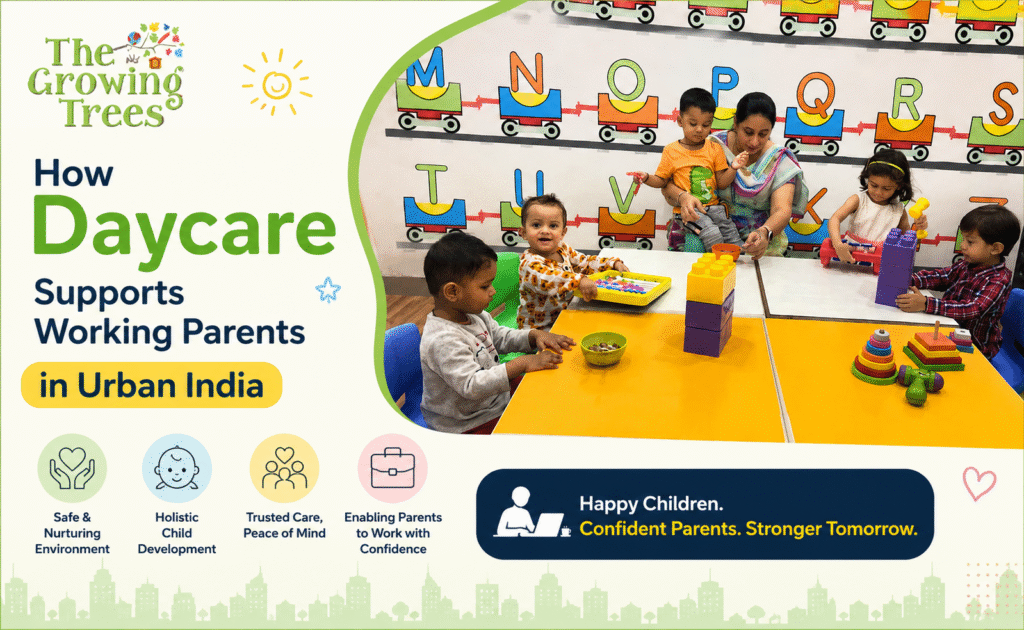
The honest answer is: choosing good daycare, really good daycare, might be one of the most thoughtful things you do for your child. Not just for yourself.
Urban India has changed. Both parents working is no longer the exception; it’s the reality for millions of families across Mumbai, Pune, Bengaluru, and beyond. And yet, the conversation around daycare still carries a faint undercurrent of judgment, as though leaving your child in someone else’s care is somehow inferior to staying home. It isn’t. What matters enormously, though, is where you leave them, and how that place treats the hours your child spends there.
The Urban Parent Dilemma Is Real, And It Deserves More Than a Quick Fix
Mumbai doesn’t slow down for school drop-offs. Commutes are long, work hours are demanding, and the concept of a “village” that once helped raise children, joint families, neighbourhood aunties, and trusted grandparents close by, is far less common than it used to be. Nuclear households are the norm. Grandparents often live in different cities. And domestic help, while helpful, isn’t a substitute for structured, emotionally attentive care.
So when families start looking for a daycare in Goregaon West or a nearby neighbourhood, they aren’t just looking for someone to watch their child. They’re looking for a second home. A place where their child is known, not just managed.
“What most parents don’t realise is that the right daycare doesn’t just support the child. It fundamentally changes the quality of life for the entire family.”
When you know your child is somewhere safe, warm, and genuinely cared for, you become a better professional. And perhaps more importantly, a calmer, more present parent when you do come home.
What “Support” Actually Looks Like for Working Parents
The word “support” gets used loosely. Let’s be specific about what working parents in urban India actually need from a daycare, and what separates a good one from the rest.
Flexible Timings That Work Around Real Schedules
A nine-to-five job is increasingly rare. Early morning meetings, late client calls, project crunches, these are part of life for most working professionals. A daycare that closes sharply at 5 PM or doesn’t allow for extended hours when needed creates more stress than it solves. At The Growing Trees, both our centres, in Goregaon West and Andheri West, are designed with the realities of working parents in mind. The programme isn’t rigid enough to punish you for running five minutes late on a difficult day.
Transparent Communication, Not Radio Silence
Here’s where things get interesting. What parents fear most about daycare isn’t the cost or the curriculum. It’s the not-knowing. What happened while I was in that meeting? Did they eat? Did they cry? Is someone paying attention to my child specifically?
This is exactly why full CCTV access, something we’ve always offered at The Growing Trees, matters more than any brochure ever could. Parents can check in. Not out of distrust, but out of love. It turns a day of worry into a day of well-done work, because the anxiety simply has nowhere to grow.
Why This Matters
Research consistently shows that parental stress about childcare quality directly affects work performance. When parents feel confident about their child’s environment, they are more focused, more productive, and less prone to burnout. Good daycare isn’t just a child development investment; it’s a professional one.
A Structured Day That Still Feels Like Childhood
Structure and warmth aren’t opposites. In fact, children, especially young ones, feel safest when there’s a predictable rhythm to their day. They know when they’ll eat, when they’ll play, when they’ll rest. This predictability reduces meltdowns, builds emotional security, and makes the transition between home and daycare feel far less jarring.
What parents often notice after a few weeks at a good daycare is surprising: their child becomes easier at home. More settled. More capable of expressing themselves. The structure doesn’t diminish them; it gives them a scaffold to grow on.
The Location Factor: Why Proximity Matters More Than You Think
For families in Goregaon West, finding a daycare centre near Yashwant Nagar or Anmol Fortune isn’t just about convenience. It directly affects the child’s experience and the parent’s peace of mind.
A long commute to daycare, even fifteen or twenty minutes each way, adds up. It adds up in exhaustion, in rushed mornings, in a child who arrives already tired before the day has begun. When the daycare is genuinely close to home, the rhythm of the day shifts. Drop-off feels less like a handover and more like a natural transition. Pickup, especially after a full day of work, doesn’t feel like another errand on an already long list.
Less travel stress means children arrive calm and ready to engage
Familiar surroundings close to home help children feel grounded
Parents can be there faster in any unexpected situation, a practical reassurance that matters deeply
Shorter pickups mean more quality time at home in the evenings
The Growing Trees has two centres precisely because we understand this. Our Goregaon West centre, easily accessible to families near Yashwant Nagar and Anmol Fortune, and our Andheri West centre serve distinctly different neighbourhoods. Because the right daycare should feel like it belongs to your community, not somewhere you have to travel to.
Early Childhood Care Is Never “Just Babysitting”
This is perhaps the most important thing to say clearly: the years from 6 months to 6 years are not a waiting period before “real” education begins. They are, neurologically and emotionally, the most formative years of a human life. The neural connections formed in this window have an outsized effect on language, emotional regulation, social skills, and even academic readiness later on.
A daycare that understands this doesn’t just keep children safe and fed. It creates an environment where learning happens through play, through relationships, through the small moments of being seen and responded to by a consistent, caring adult.
When a child in a good daycare in Goregaon West starts forming friendships, managing small conflicts, following simple group routines, and expressing their needs with growing confidence, these aren’t accidents. They’re the result of intentional, skilled care. The kind of care that working parents can’t always provide at home, not because of any failing, but simply because work exists and life is full.
The Working Parent’s Quiet Guilt, And How to Reframe It
Let’s talk about something that doesn’t get said enough: the guilt working parents carry is often inversely proportional to the quality of their childcare. When the daycare is genuinely good, the guilt quietly fades. Not because the parent stops caring, but because they can see, really see, that their child is thriving.
At The Growing Trees, we’ve watched this transformation happen across hundreds of families over nine years. A parent walks in on their first visit, visibly anxious, searching for reassurance. Three months later, they tell us their child runs to the classroom door before they can even say goodbye. That isn’t something you can manufacture. It’s built on consistent, patient, emotionally attuned care, day after day after day.
“The goal was never to replace parents. It was to make sure that every moment their child spends away from them counts for something real.”
What to Actually Look For When Choosing a Daycare
Beyond the brochure, beyond the social media feed, there are a few things that tell you more about a daycare than any marketing material ever will.
- How does the staff greet your child on the first visit? Do they get down to eye level? Do they speak to the child, not just the parent?
- How are transitions handled? What happens when a child cries? Is there patience, or is there distraction and rushing?
- Do parents feel welcome to ask questions? A centre with nothing to hide welcomes curiosity.
- Is the environment calm, not silent, but calm? Noise and energy are fine. Chaos without attention is not.
- What does the feedback loop look like? Will you know what your child ate, how they slept, what made them laugh today?
These aren’t luxury asks. They’re the baseline for a daycare that actually supports families, not just manages children.
A Small School That Makes a Real Difference
Urban India’s working parents deserve childcare that matches the seriousness with which they take both their careers and their children. The two aren’t in conflict. They never were. The missing piece, very often, is simply a daycare that holds up its end of the relationship, reliably, warmly, and with genuine attention to who each child is.
At The Growing Trees, we were built by a parent who needed exactly that and couldn’t find it. Nine years, two centres, and over 2,000 children later, that original intention hasn’t changed. Every child who walks through our doors, whether they’re six months old or twelve years old, deserves to feel like they matter here. Not because of what they achieve, but simply because of who they are.
For working parents in Goregaon West and Andheri West, that’s not a small thing. That might be everything.
Ready to See It for Yourself?
Come visit us at our Goregaon West or Andheri West centre, no pressure, just a warm walk-through so you and your child can get a feel for the space.
Book a Visit