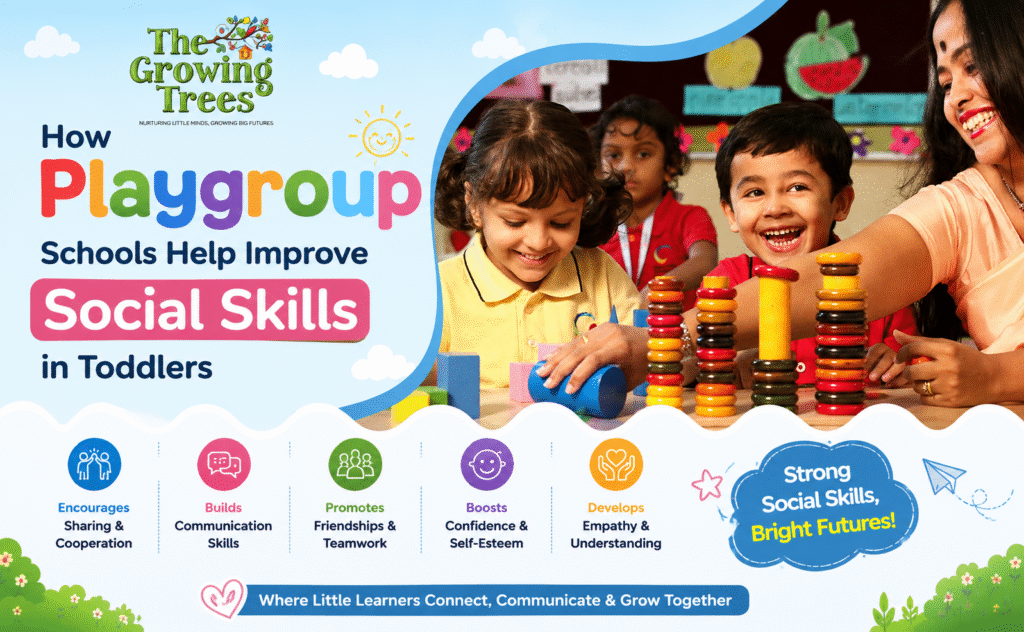
Social skills do not arrive in a toddler’s life fully formed. They are built slowly, quietly, and almost always through lived experience, through bumps, giggles, disagreements, and shared discoveries with other children. And one of the most natural places for all of that to happen is a good playgroup school.
At The Growing Trees, we see this unfold every single day. Children who arrive clinging to a parent, unsure of where to look, slowly become the ones who walk in, find a friend, and dive right in. It does not happen overnight. But it does happen, and the environment your child is placed in makes all the difference.
Why Social Skills Cannot Be Taught at Home Alone
Parents often ask, ” My child plays with cousins, with the neighbour’s kids, with me. Is that not enough?
The honest answer is: it helps, but it is not quite the same.
Here is where things get interesting. The dynamics of a playgroup are distinct from those of home-based interactions. In a playgroup setting, children encounter peers they did not choose, in a space that belongs to everyone equally, with no single adult dedicated only to them. That creates a kind of low-stakes social pressure that actually accelerates development.
They have to figure out how to get someone’s attention. How to wait for their turn. How to react when someone takes the block they were using. How to join a group that is already playing. These are not skills you can rehearse at home with a patient parent. They emerge only when children are around other children.
A thoughtfully run playgroup school in Goregaon West gives toddlers a safe place to practise all of this every single day.
What Actually Happens in a Playgroup, and Why It Matters
Learning to Share Without Being Forced
Most toddlers between the ages of 2 and 3 are firmly in the “mine” phase. It is entirely developmentally normal; they are still working out where they end, and the world begins.
What we have noticed over the years is that forcing people to share rarely works. What does work is repeated, natural exposure to situations where sharing is simply part of life. When a child sees that giving something up leads to a smile, or that taking turns means the toy comes back, they begin to understand, on their own terms, that generosity has social rewards.
A good playgroup creates those situations organically. Not by lecturing a two-year-old on the ethics of fairness, but by setting up an environment where sharing happens naturally as part of play.
Learning to Communicate What They Feel
Toddlers experience enormous emotions and have very limited language to express them. The result is often a meltdown, a grab, a push, not because the child is difficult, but because they simply do not yet have the words.
In a playgroup environment, children are gently guided to name their feelings. “You seem upset. Can you tell me why?” Over weeks and months, this kind of patient, consistent interaction builds emotional vocabulary. And a child with an emotional vocabulary is a child who can navigate relationships with classmates, teachers, and, eventually, the world.
This is one of the things we take seriously at The Growing Trees. The way a teacher responds to a two-year-old’s frustration shapes how that child learns to handle frustration for years to come.
Understanding That Others Have Feelings Too
Empathy is not an innate setting that switches on at a certain age. It is developed through exposure to others, through watching someone cry and feeling something about it, through noticing a friend’s face when something goes wrong, and through being on the receiving end of kindness.
Playgroup is where this begins. When children spend consistent time together, they start to read each other. They notice moods, reactions, and preferences. And gradually, slowly, imperfectly, they begin to factor others into their actions.
That is empathy in its earliest form. And it is one of the most lasting gifts a playgroup experience can give a child.
The Role of Structure and Routine in Social Development
Parents searching for a playgroup school near Goregaon West sometimes assume that more academic structure is better. The newer the curriculum, the more impressive the programme.
What actually matters most at this age is something quieter: predictable routine.
When a child knows what comes next, circle time, free play, snack, and outdoor time, they feel safe. And safety is the prerequisite for all social exploration. A child who is anxious about what is happening around them cannot focus energy on connecting with others.
At The Growing Trees, the day is paced intentionally. Not rushed, not overloaded. The structure gives children the psychological security to take social risks, to approach a new child, to try a new game, to speak up in a group for the first time.
Small Moments That Build Big Confidence
One of the most underrated aspects of a good playgroup in Goregaon West is what happens in the unstructured pockets of the day: the five minutes before a meal, the free-play corner, the outdoor area.
These are the moments where children negotiate, experiment, and discover who they are in relation to others. A child who has been talking all morning suddenly learns how to listen when someone else has the floor. A quiet child who never initiates at home surprises everyone by taking the lead in an imaginary game.
These small moments are not random. They are made possible by an environment that is set up to invite social exploration, diverse materials, open spaces, a low child-to-teacher ratio, and educators who observe rather than over-direct.
What most people do not realise is that children do not need to be pushed toward social development. They need to be given the conditions for it to happen naturally.
What Parents Often Notice After a Few Months
The changes are rarely dramatic. They creep in quietly.
Parents who enrol their children at The Growing Trees often tell us, usually around the three-month mark, that something has shifted. Their child has started saying “please” unprompted. They now wait at the dining table instead of demanding food immediately. They show concern when a sibling falls. They walk into a room full of people without hiding behind a parent’s leg.
None of these things was directly taught. They were absorbed through the daily rhythm of playgroup life, through hundreds of small interactions with peers, and with caring adults who modelled respectful, patient communication.
That is how social learning works. Not through instruction, but through immersion in the right environment, with the right people, at the right stage of development.
Choosing the Right Playgroup Matters More Than You Think
Not every playgroup is the same. The difference is not always visible in a brochure or a facility tour. It lives in the small decisions, how a teacher responds when two children fight over a toy, whether children are rushed through activities or given time to explore, whether the environment feels warm or merely organised.
If you are looking for a playgroup school in Goregaon West that genuinely prioritises your child’s emotional and social growth, not just curriculum milestones, it is worth spending time understanding the programme’s philosophy, not just the schedule.
At The Growing Trees, every aspect of the day, from how children are greeted in the morning to how disagreements are handled on the floor, is shaped by one core belief: that children grow best when they feel safe, seen, and genuinely cared for.
A Final Thought for Parents
The years between two and five are extraordinary. The social patterns being laid down right now, how your child relates to others, manages conflict, asks for what they need, and shows kindness, will echo into their school years and beyond.
Playgroup is not just childcare. It is, done right, a child’s first experience of community. Their first rehearsal for the social world.
If you would like to understand how The Growing Trees approaches this through our playgroup and preschool programmes in Goregaon West and Andheri West, we would love to have you visit. See the space, meet the teachers, and see for yourself what a morning looks like.
Because some things are better experienced than explained.