One day, your child is a baby who cannot hold a spoon. A few years later, they are asking questions you were not prepared for, forming opinions, making friends, and telling you, firmly, how they prefer their sandwich cut.
What happened in between? A tremendous amount of brain development, social wiring, emotional learning, and cognitive growth. Most of it is invisible. All of it is irreversible in its timing.
The early years, roughly from birth to age six, are now well understood by developmental researchers to be the most formative period in a human being’s life. Not because what happens later does not matter, but because what happens now creates the architecture on which everything else is built.
This is not a reason to panic. It is a reason to be intentional.
And it is precisely why the question of early education, what it means, what good preschool actually does, and why it matters so much, deserves more than a quick Google search before admissions season.
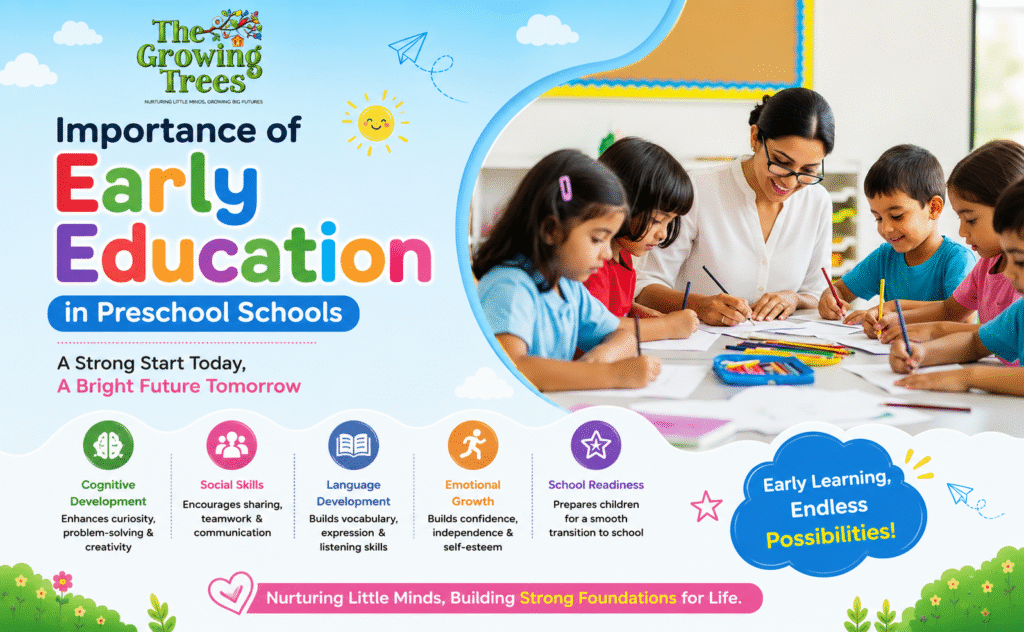
What “Early Education” Actually Means
There is a common misconception that early education is essentially a head start on the school syllabus, teaching letters and numbers earlier, so a child is ahead when formal schooling begins.
That is not what early education is, and honestly, that framing misses the point entirely.
What early education, done well, actually does is far more foundational. It shapes how a child learns, not just what they learn. It builds the emotional and cognitive habits that determine whether a child becomes curious or anxious in the face of new challenges, confident or withdrawn in social situations, or persistent or easily frustrated when something is difficult.
At the best preschools in Goregaon West, you will not find children sitting in rows, memorising the alphabet by rote. You will find them building things, asking questions, working through disagreements with peers, and developing, brick by invisible brick, the foundations of a genuinely capable human being.
The Brain at Three Is Not a Smaller Version of an Adult Brain
One of the most important things to understand about early childhood is that the young brain is not simply an underdeveloped version of an adult brain. It operates differently, develops at a staggering pace, and is uniquely receptive to certain kinds of input during specific windows of time.
By age three, a child’s brain has already formed roughly one thousand trillion synaptic connections, more than at any other point in life. The brain then spends the next several years pruning those connections, strengthening the ones that are used repeatedly and letting go of those that are not.
Here is where things get interesting for parents: the connections that get reinforced during these years are shaped directly by experience. By the conversations a child has, the problems they are given space to work through, the emotions they learn to name and regulate, and the relationships they form with caring, consistent adults.
A thoughtfully designed preschool environment is not a luxury add-on to this process. It is one of the most significant inputs shaping it.
What Preschool Actually Builds, Beyond the Obvious
Language and Communication That Goes Beyond Vocabulary
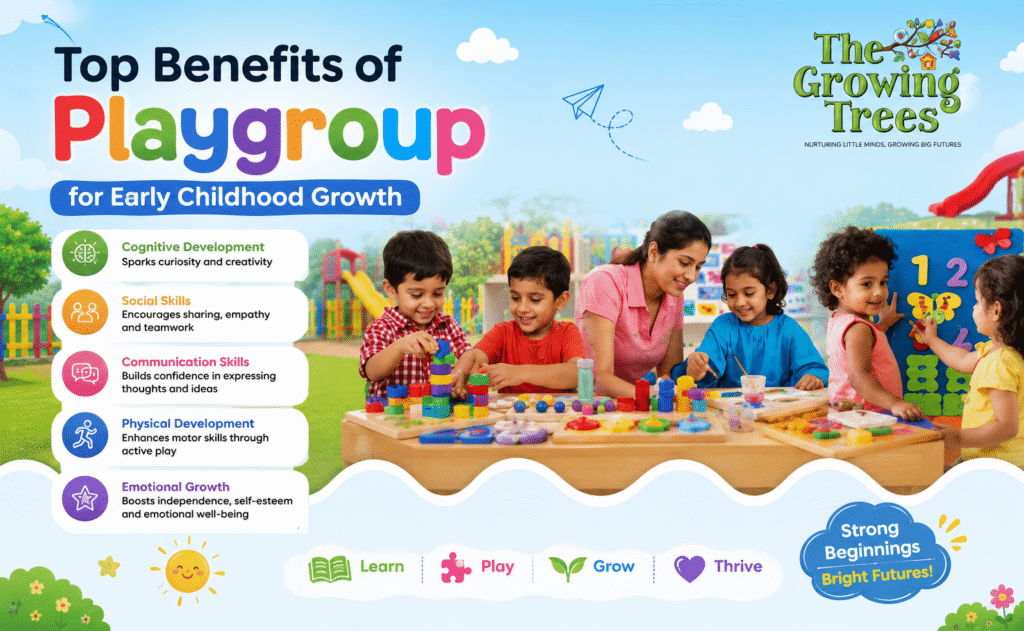
Most parents understand that preschool helps children develop language. What is less obvious is how this happens, and how much deeper it goes than simply learning new words.
Children develop language not by being taught it, but by being immersed in rich, responsive communication, conversations where someone genuinely listens to what they are saying, responds to the meaning behind it, and extends the idea further.
At a good preschool in Goregaon West, this happens dozens of times a day. A child points at something, and a teacher does not just name it; she asks a question back. Encourages a thought. Waits for the child to fumble through expressing something complex. That patient back-and-forth, repeated consistently, does more for language development than any flashcard programme ever could.
Emotional Regulation, The Skill Schools Rarely Discuss
Here is what most preschool brochures do not mention: the ability to manage emotions is one of the strongest predictors of long-term success in academics, relationships, and professional life.
A child who can sit with frustration without melting down, who can recover from disappointment, who can calm themselves after an upset, that child has an enormous advantage in every environment they will ever enter.
Preschool, when it is run with warmth and intention, is where this capacity is first developed. Through small moments, a toy that does not work as expected, a turn that takes too long, a friend who says something unkind, children learn, with adult guidance, to identify what they are feeling and find ways to move through it.
This is not something that can be rushed or scheduled. It builds through repeated experience, over months, in a consistent environment with caring adults who respond thoughtfully rather than reactively.
The Social Architecture of Early Friendships
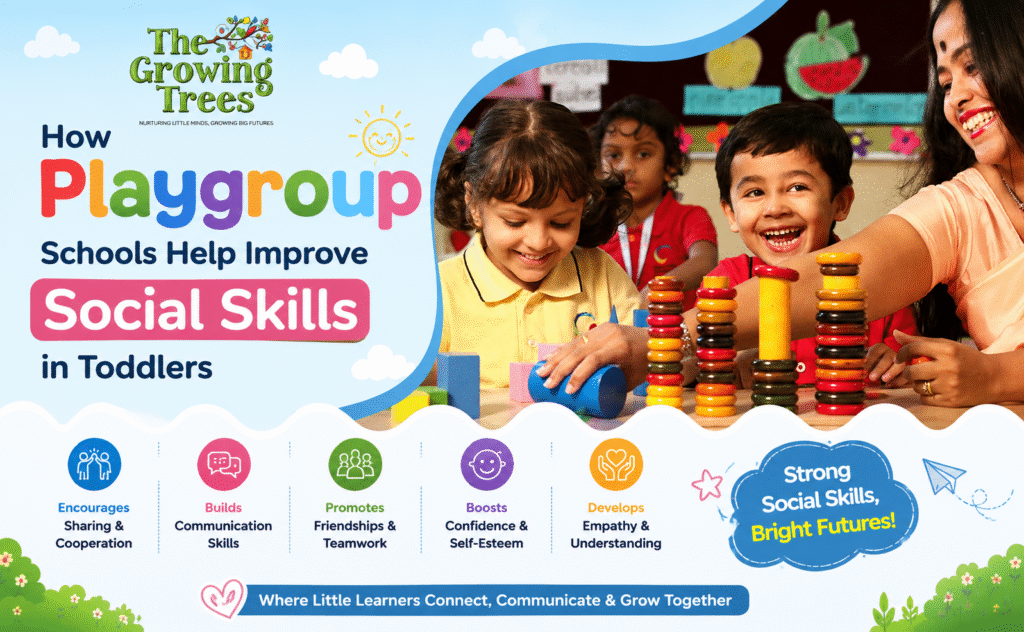
There is something that happens when two three-year-olds decide, entirely on their own terms, that they are friends. A wordless negotiation, a shared interest, an unspoken agreement. And then, with remarkable frequency, a disagreement that tests all of it.
Navigating early peer relationships is genuinely complex work for a young child. Learning to notice what others are feeling, to advocate for themselves without aggression, to repair a small conflict, and to choose to try again are skills with lifelong consequences.
The best preschool near Goregaon West creates the conditions for these social experiences to happen daily, with adults nearby who can guide without over-managing, and who understand that some degree of friction between children is not a problem to be solved but a process to be supported.
Why the Environment Matters as Much as the Curriculum
Parents researching preschool with daycare near Goregaon West will encounter a wide range of programmes, philosophies, and facilities. It can be difficult to know what to compare.
Our experience, across more than nine years and over two thousand children at The Growing Trees, is that the curriculum matters far less than the environment in which it is delivered.
The same lesson plan can produce very different outcomes depending on whether children feel safe, whether teachers are warm and consistent, whether the day is paced thoughtfully rather than packed with activity, and whether mistakes are treated as part of the learning process rather than something to be corrected quickly.
What you are really assessing when you visit a preschool near Goregaon West is not the resources on the shelves or the theme on the wall. It is whether the children in that room look comfortable. Whether the teachers are on the floor with them. Whether there is a quality of calm, purposeful engagement in the air.
That environment, that feeling, is the curriculum.
The Working Parent Question: Does Starting Earlier Really Help?
For families where both parents work, early preschool enrolment is often driven partly by practical need. And some parents carry quiet guilt about it, wondering whether they are choosing convenience over their child’s best interests.
What research consistently shows, and what we have seen firsthand, is that high-quality early education is genuinely good for children, not in spite of their parents working, but as a complement to the love and attention children receive at home.
A good preschool in Goregaon does not replace what a parent gives. It adds an entire dimension of experience that home life, however warm and stimulating, cannot replicate: peer relationships, group dynamics, the experience of belonging to a community beyond the family.
Children who attend thoughtfully run early education programmes arrive at primary school not just academically prepared, but socially confident, emotionally grounded, and genuinely excited to learn. That combination is rare. And it is far more valuable than any head start on phonics.
What to Look For When You Are Choosing
If you are in the process of finding a preschool in Goregaon West for your child, here are the things that matter most, and that are easy to miss in a standard facility visit.
Watch how teachers respond, not what they say. A prospective parent should observe how a teacher handles a child who is upset, a disagreement between two children, or a moment of refusal. The response in that moment tells you everything about the school’s emotional climate.
Notice whether children seem genuinely absorbed or just occupied. There is a difference between a classroom that is busy and one where children are truly engaged. Look for focus, curiosity, and the kind of productive noise that comes from children actually working something out.
Ask about the daily rhythm, not just the programme. How a day is paced, how transitions are handled, whether rest time is built in, and how much child-directed free play is protected matter enormously for young children’s wellbeing and development.
Trust your instincts about warmth. You will feel, fairly quickly, whether the people in that building genuinely love what they do. That feeling is data. Do not ignore it.
The Years You Cannot Get Back
Early education is not about pressure. It is not about acceleration or competitive advantage or getting your child ready for an entrance exam at age four.
It is about recognising that the years between two and six are singular in their developmental richness, and making sure your child spends them in an environment that honours that richness, rather than rushing past it.
At The Growing Trees, this understanding shapes everything, from how we greet a child in the morning to how we handle the quiet moments in the middle of the day. We are not trying to produce impressive children. We are trying to support whole ones.
If you are looking for a preschool with daycare near Goregaon West that brings together genuine warmth, thoughtful early learning, and the kind of transparent, parent-inclusive approach that lets you feel connected to your child’s day even when you are not there, we would love to have you come and see what a day at The Growing Trees actually looks like.
Because some things are better seen than explained.